

COOL-FX BIOBASED COOLS POULTRY BARNS AND CUTS ENERGY USE
Poultry farmers need stable barn temperatures to protect bird health and keep energy costs under control. At BEST Tavukçuluk in Ankara, Türkiye, Cool-FX Biobased was sprayed on one barn roof and compared with an identical uncoated barn over a 42-day cycle. The coated barn was up to 7.3 °C cooler, used 12% less electricity and lost 21% fewer birds.
HEAT CONTROL IN POULTRY BARNS
Heat stress is a constant risk in poultry houses during Turkish summers. High barn temperatures affect bird health, push up ventilation and cooling costs, and can reduce production results.
Cool-FX Biobased is a removable reflective roof coating that lowers the heat load entering the barn. The trial at BEST Tavukçuluk in Ankara set out to measure its effect on temperature, electricity use and flock performance.
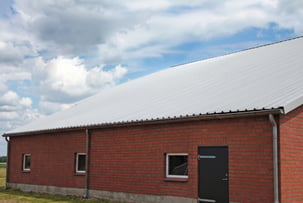
The trial setup:
Two identical barns, one coated roof
Both barns measure 16 m x 120 m (1,920 m²), with a ceiling height of 4.70 m. Each has 13 fans of 38,000 m³ capacity and 70 ventilation hatches that can each transfer 1,700 m³ of air.
Six buckets of Cool-FX Biobased (6 x 20 kg), diluted 1:3 with water, were sprayed manually on one roof. The second barn stayed uncoated as a control. Both barns received the same feed during the 42-day cycle, from 10 August to 21 September 2024, with 33,255 chicks placed in each.

Product
Cool-FX Biobased
Industry
Livestock (poultry)
Region
Türkiye (Ankara)
Size
2 barns of 1,920 m²
Temperature difference
Cooler inside the coated barn at 15:00 (27.6 °C against 34.9 °C), measured in the empty barn on 8 August 2024: a 7.3 °C difference.
Electricity use
The coated barn used 4,129.7 kWh over the 42-day cycle, against 4,684.8 kWh in the uncoated barn: 12% less electricity.
Bird losses
1,101 birds were lost in the coated barn against 1,397 in the uncoated barn, out of 33,255 chicks each: 21% fewer losses.
TEMPERATURE: ROOF AND BARN INTERIOR
Surface temperatures were measured with a DJI Mavic T3 infrared drone during the application: 34.5 °C on the coated roof against 49.2 °C on the uncoated roof, a difference of 14.7 °C.
Inside the empty barns on 8 August 2024, before the chicks arrived and with fans and cooling pads off, the coated barn stayed cooler at every reading: 26.1 °C against 32.2 °C at 13:00 (outside: 34.4 °C), 27.6 °C against 34.9 °C at 15:00 (outside: 39.4 °C) and 27.2 °C against 33.8 °C at 18:00 (outside: 36.6 °C).
Once the chicks arrived, both barns had to hold 33 °C on the first day, then lower the temperature gradually to 20 °C by day 42. The coated barn is expected to show smaller temperature fluctuations, which benefits bird health and electricity use.
WHAT THE TRIAL SHOWED
Compared with the uncoated barn, the coated barn performed better on every indicator measured. Three findings stand out.
Fewer losses:
1,101 birds were lost in the coated barn against 1,397 in the uncoated barn (21% fewer), out of 33,255 chicks each over the 42-day cycle.
More meat from less feed:
By day 35, the coated barn produced 69,388 kg of meat (including bones) against 67,602 kg (3% more), while consuming 94,900 kg of the same feed against 96,400 kg (2% less).
Better feed conversion:
The feed conversion ratio (FCR) reached 1.36 against 1.42 in the uncoated barn (4% lower), well below the expected maximum of 1.47 at day 35. A lower FCR means more efficient use of feed.
Other factors, such as the genetics of the parent animals, crowding, rapid temperature drops, ventilation and diseases, may also have influenced these results.
The uncoated barn consumed 12% more energy compared to the coated barn.
BEST Tavukçuluk A.Ş.
Field trial report, 2024
Cooling Coatings
Cool-FX Classic
A water-based coating that lowers roof and indoor temperatures across the warm season.

Cool-FX Biobased
A biobased, biodegradable coating that cools buildings and helps meet environmental standards.

Cool-FX Asia
A wear-resistant coating that keeps cooling buildings through hot, high-rainfall seasons.

Need help finding the right product?
Hey, I'm Frederic, ready to help.
Related cases
How shading improved strawberry colour
A strawberry grower in South-West France builds a two-layer greenhouse shading strategy, applied by drone. See the choices, the advice and the results.
ReduFuse IR protects young cucumber plants from heat
Two young plant growers apply ReduFuse IR as a temporary coating. See how diffused light and heat protection help cucumber plants grow.
Unsure which shading to choose?
Our team is happy to help you find the right Sudlac shading for your crop and climate. Get in touch and we will advise you and connect you with a dealer near you.